Great Seal of the United States
The Lost SymbolThe Great Seal of the United States becomes a working clue in the pursuit of Robert Langdon and Katherine Solomon: first a design to be overlaid and deciphered on a dollar bill, then a bronze landmark that helps the fugitives orient themselves across Freedom Plaza. Its importance lies in the shift from a familiar national emblem—initially dismissed as a coincidence—to a device that joins symbolic interpretation to movement through the city.
Image and Interpretation
On the reverse of a dollar bill, Katherine Solomon draws the Jewish star, also called the Seal of Solomon, over the pyramid in the Great Seal. The placement is exact: the star’s top vertex aligns with the all-seeing eye, while its other five points fall on letters that spell MASON. Katherine presents the alignment to Robert Langdon as the key to understanding the pyramid and capstone, redirecting their journey away from their expected destination and toward Freedom Plaza.
Langdon’s first response is skepticism. He recognizes the arrangement as an image circulated by conspiracy theorists as supposed proof of Masonic influence over the early nation. To him, the fit between the star and the letters initially looks coincidental, and he cannot see why it should affect their destination. Katherine’s insistence that he look where she is pointing turns the same familiar graphic into a clue: the design has not changed, but its meaning in the immediate search has.
The Seal at Freedom Plaza
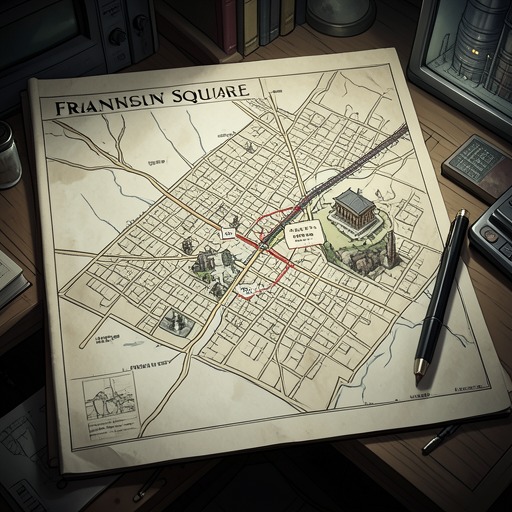
The physical setting makes the emblem more than an image on currency. Freedom Plaza, at Pennsylvania Avenue and Thirteenth Street, is itself a map: its broad inlaid surface depicts Washington as Pierre L’Enfant originally envisioned it. Embedded in the plaza is a famous bronze cast of the Great Seal, described as one of the largest bronze medallions ever cast. Langdon and Katherine reach it, inspect it, and point southwest, using the plaza’s map and the seal as reference points in deciding where to go next.
The seal therefore links two kinds of reading. On the bill, the superimposed star exposes a pattern in the letters; at the plaza, the bronze medallion sits within a map that can be read geographically. Langdon asks which direction Alexandria lies, and the taxi driver, Omar Amirana, points southwest—the direction the pair had already indicated. Langdon’s recognition confirms their destination, while Katherine identifies the nearby Metro route: the Blue Line to King Street Station.
A Clue Passed On
The marked dollar bill remains behind as the fugitives leave. After Langdon and Katherine pay Omar Amirana, he notices the star drawn over the Great Seal and sees that its points fall on letters spelling MASON. When Turner Simkins arrives, Omar hands him the bill and connects the Masonic clue to Alexandria, where the George Washington Masonic Memorial stands directly across from King Street Station. The emblem thus passes from Katherine’s interpretation to Langdon’s recognition, and then to Omar and the pursuing agents as evidence that helps them infer the fugitives’ likely destination.
That inference comes too late to stop the escape at Freedom Plaza. The agents discover that Langdon and Katherine have taken the Blue Line, and Simkins orders the helicopter to King Street Station in an attempt to get there before them. The seal does not simply identify a symbol or a building: in combination with the mapped plaza, the marked bill, and the direction of travel, it contributes to a chain of deductions that both guides the fugitives and gives their pursuers a new lead.
Narrative Function
The Great Seal’s role turns on a contrast between an apparent coincidence and a usable pattern. Langdon initially treats the star-and-letter alignment as familiar conspiracy imagery, while Katherine sees its relevance to the puzzle before he does. At Freedom Plaza, their reading becomes practical: they move from interpreting a graphic to locating themselves on a map and choosing a route out of the agents’ reach.
The emblem also gives the chase a material trail. The design appears first on the bill Katherine marks, then in bronze on the plaza, and finally again on the bill Omar passes to Simkins. These appearances connect private decipherment, public space, and pursuit without making the seal itself a complete answer. It points toward MASON and helps establish Alexandria as the next destination; the larger search remains unresolved as the subway carries Langdon and Katherine away beneath the plaza.